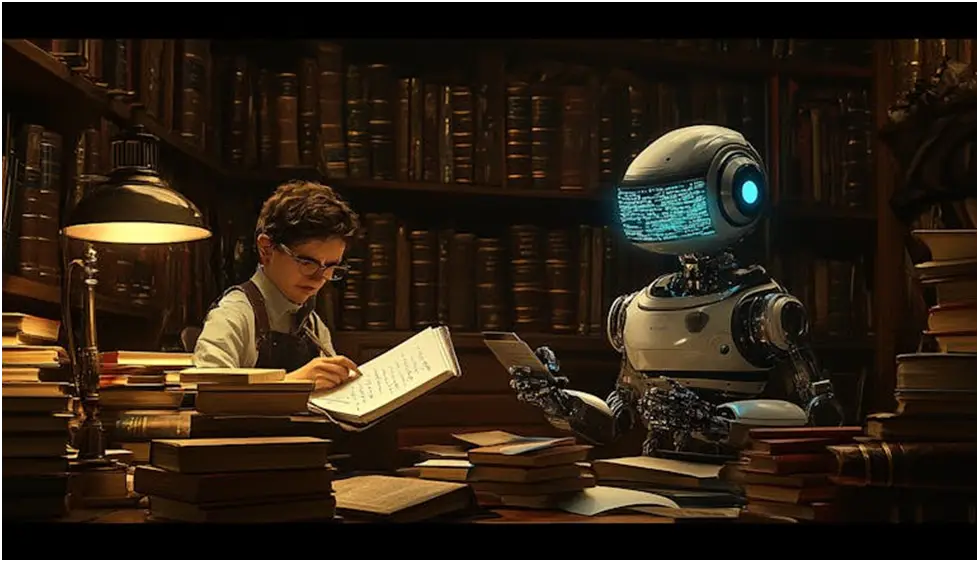
Imagine picking up a novel and wondering whether the mind behind those words was human or an AI book writing generator. It’s no longer pure science fiction; it’s today’s reality. While AI boasts unparalleled efficiency—churning out text at lightning speed—questions arise about its impact on genuine storytelling. Can algorithms replicate the nuances of emotion or the instinctual genius of human creativity? This article delves deep into these questions, exploring how technology reshapes the writing landscape and probing whether this revolution bolsters or diminishes literature’s soul.Join us as we explore this fascinating intersection of art and technology—a place where silicon meets ink, challenging our understanding of authorship in profound new ways.
The Evolution of AI in Writing
Milestones where AI began to challenge human authorship have punctuated this evolution like plot twists in an adventurous tale. One significant event was in 2016 when the Hoshi Shinichi Literary Award saw its first story co-authored by an AI making it to the contest’s finals—a startling recognition for machine-assisted creativity. More recently, headlines were made when press releases composed by machines could hardly be distinguished from those painstakingly penned by humans. The growing frequent use of tools like Jasper and Copysmith highlights this burgeoning parity further, rendering briefings and content creation more efficient yet eerily human-like.
These technological strides have left ripples across the literary domain, igniting debate among writers and readers alike about the essence of authorship and originality. While AI-generated content floods blogs and news sites with unprecedented swiftness, traditionalists worry over losing the quintessentially human soul present in literature crafted by flesh-and-blood creators. Publishers cautiously weigh these innovations’ benefits against potential disruptions to industry standards around originality and voice authenticity. As boundaries continue to blur between man-made prose and machine-generated text, audiences face an evolving landscape where storytelling itself may soon blend seamlessly between its organic roots into something distinctly futuristic—a hybridization borne of necessity as much as fascination with possibility.
Human Creativity: An Irreplaceable Element
Consider the creative odyssey of J.K. Rowling while writing “Harry Potter.” She sketched characters not from data-driven blueprints but from visceral intuition during life’s mundane moments—on train rides or at a café window—all shaping why her stories evoke such universal and timeless recognition. Such alchemy is rooted in the personal touch, capturing spontaneous moments that humans alone can orchestrate with such depth and texture. In contrast to formulaic writing techniques present in AI-generated text, these emotionally-charged wizardries remain beyond silicon’s grasp.
The difference might be akin to hearing a heartfelt live symphony versus pre-recorded tracks played by mechanical precision; both hold value, yet the former stirs something instinctive within us. While technology advances at lightning speed, reimagining creativity’s boundaries every day, there exists an enduring need for storytelling’s raw soul which thrives on empathy and shared experiences only humans offer—a continuum echoing ancient oral traditions where every story told linked people closer together through time immemorial. In this dance between man and machine lies literature’s future: A balance maintaining humanity’s long-standing liaison with intuitive narrative as machines enhance paths we tread upon it.
The Role of Efficiency: How AI Transforms Writing Tasks
For many writers facing the blank page, writer’s block is the arch-nemesis. Yet with AI tools like OpenAI’s ChatGPT or other predictive text applications, ideas flow more smoothly. Writers have reported using AI to generate initial drafts or brainstorm ideas—much like bouncing concepts off an impartial friend who never tires of listening. It doesn’t dictate direction but nudges the muse awake when inspiration falters. From handling research efficiently to flagging plot inconsistencies across chapters, AI acts as a dependable co-pilot rather than an autopilot.
Furthermore, there’s concrete evidence supporting how AI can affect productivity positively in terms of time and cost savings. A study by McKinsey found that digital technologies including AI could increase productivity by up to 40 percent in certain industries—a statistic that’s not far-fetched in publishing either. Freelancers using advanced editing bots save hours normally spent poring over grammatical errors while large-scale publishers cut expenses significantly by automating rote editorial tasks with machine learning algorithms.
Ethical Concerns: Authorship and Ownership
As creativity meets technology, intellectual property rights become another tangled web. Traditionally, authorship has granted both moral and economic ownership of work; however, when an algorithm plays co-writer, these conventions blur significantly. Some argue that machines lack true agency or intent; hence they cannot hold claims to authorship beneath traditional frameworks. These puzzles extend even further when considering recompense—should revenues from mixed-authorship works be subject to legal structures entirely different from those dictated by human-only creations?
Amidst this digital evolution grows a demand for transparency that’s larger than ever. Readers yearn not just for stories but context too—how much should they know about which passages were AI-penned versus crafted by human hands? A lack of clarity could invite suspicion; fans might wonder how genuine certain emotions are or whether their beloved author has given way entirely to cold computations. As publishing companies tiptoe through these ethical minefields, society grapples with finding safeguards that balance innovation with trustworthiness in revealing technological collaboration without diminishing perceived authenticity.
Reader Perceptions: Does It Matter Who Wrote It?
In a world where AI authorship is becoming commonplace, one might wonder if readers can spot the difference between text generated by a machine versus that crafted by human hands. Research seems to suggest a growing blur in the line that separates the two. A study conducted by Stanford University explored this fascinating question by presenting participants with various texts, some authored by AI and others by humans. Results revealed that readers often struggled to discern who—or what—had penned the sentences before them.
Yet, while distinction may seem elusive, reader preferences tell a different story. In surveys asking about authenticity in writing, many respondents express an enduring desire for the genuine touch of human creativity. For instance, a poll administered by the Reader’s Digest consistently shows that individuals value content reflecting personal experiences and emotive storytelling—elements often perceived as uniquely human traits. This could be why traditional forms of literature still hold a cherished place on many bookshelves despite advancements in AI technology.